
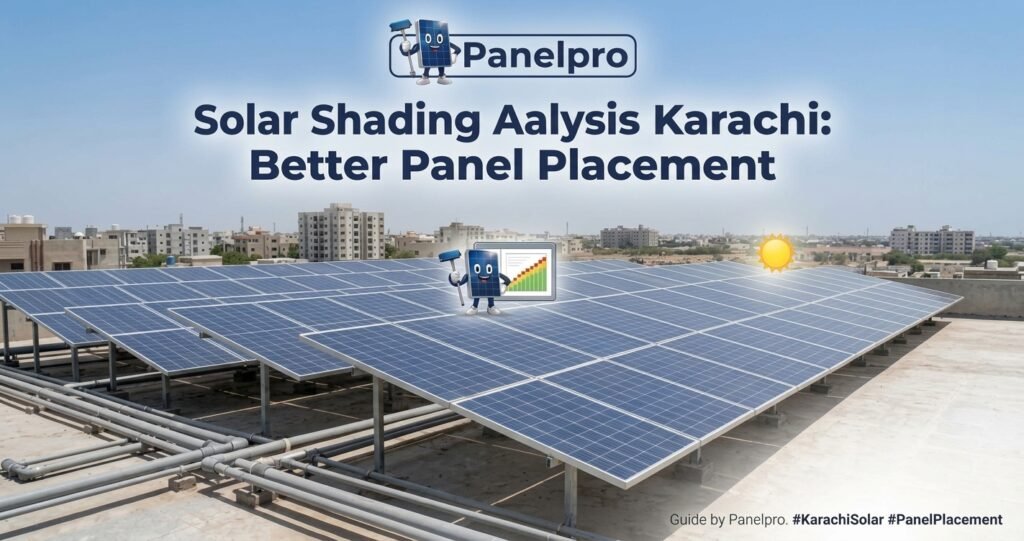
Solar panels need sunlight, but the amount of usable sunlight can change significantly across a rooftop. A water tank, parapet wall, nearby building, tree, satellite dish, or even another panel row can create shadows during different parts of the day. That makes Solar Shading Analysis Karachi an important part of modern solar planning. Instead of asking only how many panels can fit on a roof, installers increasingly need to consider where those panels will receive the strongest and most consistent sunlight.
Global solar deployment is expanding rapidly. IRENA reports that the world added 510.3 GW of solar PV capacity during 2025, showing how quickly PV systems are scaling worldwide.
Why Shading Deserves Attention Before Installation
A rooftop can look completely sunny when viewed at midday and still experience significant shading during morning or afternoon hours.
This is where Solar Shading Inspection Karachi becomes useful. A proper assessment considers surrounding buildings, roof structures, trees and the movement of the sun across different hours.
The objective is not simply to find one shadow. It is to understand the pattern.
Recent experimental research has shown that partial shading can produce substantial reductions in PV output, demonstrating why shading deserves attention during system design rather than after installation.
How Solar Shading Analysis Works
A professional Solar Shading Analysis Karachi assessment can begin with the roof’s physical layout. Technicians or designers identify obstructions and examine their likely effect throughout the day.
The analysis can consider:
- building height and nearby structures;
- parapet walls and rooftop equipment;
- trees and future growth;
- panel-row spacing;
- seasonal sun movement;
- morning and afternoon exposure.
Modern digital modelling can also help estimate how shadows move across a site.
This makes Solar Shading Inspection Karachi more useful than a quick visual check because a rooftop changes throughout the day.
Better Panel Placement Can Protect Generation
Panel quantity is important, but placement can be just as important.
Solar Panel Placement Karachi should account for the areas of the roof that receive consistent sunlight rather than filling every available space automatically.
For example, placing additional modules close to a tall parapet may increase the panel count while creating recurring shade. Moving the row slightly may provide better exposure across important generation hours.
Research published in 2026 continues to examine how changing shading patterns and PV configurations affect energy performance, reinforcing the importance of spatial planning in solar design.
Karachi Rooftops Have Their Own Shading Challenges
Karachi’s dense urban environment creates different shading conditions from open rural sites.
Neighbouring buildings can block low-angle sunlight. Water tanks, stair-head rooms, parapets and rooftop equipment can create localized shadows. Trees can also become larger obstruction sources as they grow.
These conditions make Solar Shading Problems Karachi particularly relevant for installations in developed residential and commercial areas.
A professional Solar Shading Inspection Karachi can identify these risks before the mounting arrangement becomes fixed.
Shading Can Also Become a Maintenance Issue
Shading should not disappear from the discussion once installation is complete.
A building constructed next door, a growing tree, a newly installed rooftop structure or a changed panel layout can introduce new shadows.
This means Solar Shading Analysis Karachi can also support performance investigations when a system produces less electricity than expected.
If production changes without an obvious equipment fault, reviewing the site’s current shading conditions can provide another useful diagnostic direction.
PanelPro for Smarter Solar Planning
PanelPro provides solar installation support, professional cleaning, inspections, performance testing and preventive maintenance across Karachi.
Its broader service approach makes Solar Panel Placement Karachi relevant beyond the initial installation stage. Good placement can make future cleaning, inspection and servicing easier while helping panels receive better sunlight.
For an existing system, Solar Shading Problems Karachi can also be investigated when owners notice unexplained differences between expected and actual production.
Why Shading Analysis Is Becoming More Important
The global PV market is becoming larger and more technically sophisticated. IRENA reported that solar PV accounted for almost all of the increase in global solar capacity in 2024, with 451.9 GW added that year.
As installations become larger, small design decisions can have a bigger operational impact.
A strong Solar Shading Inspection Karachi therefore looks beyond today’s visible sunlight. It considers the rooftop environment, surrounding structures and how shadows change during operating hours.
For new systems, Solar Panel Placement Karachi should be decided alongside the overall system layout. For existing systems, Solar Shading Problems Karachi can be part of a wider performance investigation.
FAQs
Solar Shading Analysis Karachi is the assessment of shadows affecting a solar installation throughout different times of the day and, where relevant, different seasons. It helps identify better locations for panel placement.
Solar Panel Placement Karachi matters because panels placed in frequently shaded areas may receive less usable sunlight. Good planning aims to position modules where sunlight exposure remains as consistent as practical.
Common causes include nearby buildings, parapet walls, rooftop rooms, water tanks, trees, satellite dishes and poorly spaced panel rows. New construction or growing vegetation can also change shading conditions.
Yes. Solar Shading Inspection Karachi can help investigate unexpected production differences in an existing system. A current assessment can reveal whether new structures, vegetation or layout changes are affecting sunlight exposure.