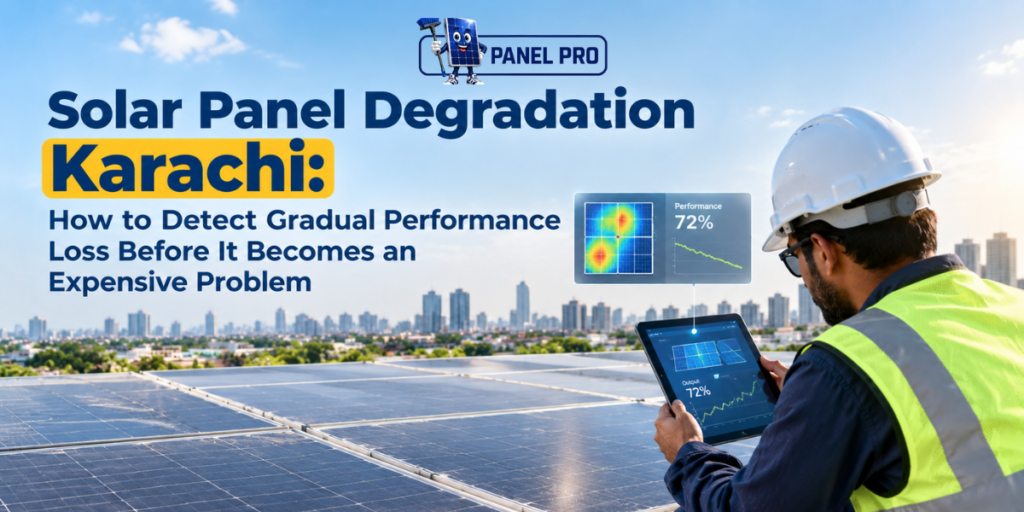
Karachi’s solar market has moved from early adoption into a much larger operating phase. Thousands of systems are now expected to produce electricity year after year, which creates a new maintenance question: how do owners know when a solar system is gradually losing performance? This is where Solar Panel Degradation Karachi becomes important.
Degradation doesn’t necessarily mean a panel suddenly fails. In many cases, output declines gradually while the system continues operating. Without proper monitoring, owners may mistake this decline for seasonal variation, dust, changing weather, or normal fluctuations in electricity generation.
The issue matters because Pakistan’s solar fleet has expanded rapidly. Renewables First estimates that the country had around 51 GW of operational solar capacity by March 2026, reflecting the rapid growth of distributed solar among households, farms and businesses.
As the installed base gets older, measuring long-term performance becomes increasingly important.
What Solar Panel Degradation Actually Means
Solar Panel Degradation Karachi refers to the gradual reduction in a module’s ability to produce electricity over time.
This process differs from sudden equipment failure.
A panel can continue producing power while its output slowly declines. The decrease may result from several mechanisms, including light-induced degradation, potential-induced degradation, cell cracks, encapsulant changes, environmental exposure, and other material ageing effects.
The IEA Photovoltaic Power Systems Programme‘s 2025 research specifically examines degradation and failure mechanisms in modern photovoltaic technologies and identifies reliability and long-term performance as important areas of PV asset management.
For Karachi owners, that means a system shouldn’t be evaluated only by whether it is still switching on each morning.
The more useful question is whether it is still producing efficiently compared with its expected performance and historical behaviour.
Why Karachi Conditions Can Make Monitoring More Important
Karachi’s environment combines high solar exposure with heat, dust, humidity, pollution and coastal conditions.
These conditions do not automatically cause abnormal degradation, but they can influence PV reliability and performance over time.
The IEA PVPS recommends climate-specific O&M because temperature, humidity, UV exposure, rainfall and wind can contribute to PV module and system failures.
This makes Solar Panel Degradation Monitoring Karachi particularly relevant for older systems and large commercial installations.
Without historical data, an owner may notice only the final symptom: lower monthly generation.
With proper records, the business can identify a pattern much earlier.
Degradation Is Not the Same as Every Drop in Output
A major problem in solar maintenance is assuming that every reduction in generation represents degradation.
It doesn’t.
A temporary decline may come from cloud cover, shading, heavy soiling, inverter downtime, electrical faults or unusual weather.
This is why Solar Performance Monitoring Karachi should compare multiple factors rather than looking at a single electricity-generation figure.
A useful performance review can consider historical production, system size, weather conditions, operating hours, inverter information and maintenance events.
For example, if production falls immediately after a period of heavy dust accumulation and improves after professional cleaning, soiling may explain much of the reduction.
If production continues falling after cleaning, technicians may need to investigate other causes.
That distinction protects owners from replacing equipment unnecessarily.
Why Solar Degradation Testing Matters
Solar Degradation Testing Karachi gives businesses a structured way to investigate whether long-term output changes indicate actual module ageing or another performance issue.
Testing can become especially useful when a system has several years of operating history.
Technicians can compare current performance with previous records and identify unusual deviations between modules, strings or system sections.
A good assessment should not rely on one measurement alone.
Instead, technicians should combine available monitoring data with physical inspection and appropriate testing methods.
This approach creates a stronger basis for deciding whether the system requires cleaning, repair, further investigation or simply continued observation.
Large Solar Systems Need Better Performance Records
For a small residential installation, a gradual performance decline may take time to become financially visible.
For a large commercial system, the calculation changes.
A small percentage reduction across hundreds or thousands of modules can represent a significant amount of lost electricity over a year.
That makes Solar Panel Degradation Monitoring Karachi particularly relevant for commercial and industrial solar owners.
A useful monitoring programme should maintain a history of production and major maintenance events.
Over time, that record can answer important questions.
When did output begin changing?
Did the change affect the entire system or only certain sections?
Did cleaning restore production?
Did the decline continue after maintenance?
Did a particular inverter or string begin behaving differently?
These questions turn solar maintenance into a data-based process.
Current PV Technology Makes Reliability More Important
PV technology continues to evolve. New module designs, larger formats, different cell architectures and new materials are changing system performance characteristics.
The IEA PVPS 2025 reliability research examines emerging degradation mechanisms and mitigation strategies across newer PV technologies.
This development makes Solar Performance Monitoring Karachi more valuable because owners need evidence about how their actual systems perform rather than relying entirely on generic assumptions about module lifespan.
The useful question is not simply how many years a manufacturer says a panel can operate.
It is how that particular installation behaves under its actual operating conditions.
What Solar Owners Should Monitor
Monthly Energy Production
Monthly production records can reveal longer-term trends that daily figures may hide.
Inverter Data
Inverter reports can identify alarms, abnormal behaviour, downtime and changes between strings.
Maintenance History
Cleaning, inspections, repairs and component replacements should form part of the performance record.
Environmental Conditions
Dust, shading and weather can explain short-term production changes and help prevent false conclusions about degradation.
System Sections
Larger installations should ideally compare individual strings or sections instead of relying only on total plant production.
Together, these records make Solar Degradation Testing Karachi more meaningful.
Preventive Maintenance Can Help Separate Causes
Maintenance and degradation analysis should work together.
PanelPro provides solar inspection, performance testing, preventive maintenance, monitoring and O&M support alongside professional cleaning.
That combination matters because a performance decline can have more than one cause.
A technician can inspect the installation, remove contamination, review visible components and analyse performance before deciding whether deeper testing is necessary.
For Solar Panel Degradation Karachi, this process helps separate temporary performance loss from longer-term degradation.
The goal isn’t to label every reduction as panel ageing.
The goal is to identify the actual cause.
Why Early Detection Protects the Solar Investment
A solar system represents a substantial investment in equipment and infrastructure.
Owners therefore need more than an installation warranty. They need visibility into how the asset performs throughout its operating life.
Solar Panel Degradation Monitoring Karachi provides that visibility by turning historical generation into useful evidence.
Solar Performance Monitoring Karachi adds another layer by helping owners identify abnormal operating patterns.
And Solar Degradation Testing Karachi can investigate those patterns when routine monitoring raises questions.
This combination gives businesses a more informed approach to long-term solar asset management.
The Future of Solar Maintenance in Karachi
Pakistan’s expanding solar base means the industry is gradually shifting from installation-focused activity toward long-term asset management.
As systems age, questions about reliability, degradation and performance will become increasingly important.
The next stage of solar ownership will therefore depend on more than installing high-capacity arrays.
It will depend on knowing what those systems actually produce over time.
For Karachi owners, Solar Panel Degradation Karachi should be viewed as a measurable performance issue rather than an abstract technical concept.
With consistent monitoring, appropriate maintenance and evidence-based testing, businesses can identify changes earlier and make better decisions about cleaning, repair, component replacement and future investment.
A solar system should not simply remain operational.
It should continue delivering measurable value throughout its useful life.
FAQs
Solar Panel Degradation Karachi can involve natural module ageing, light-induced degradation, potential-induced degradation, cell damage, environmental exposure and other material-related mechanisms. Actual causes require system-specific assessment.
Solar Panel Degradation Monitoring Karachi compares historical production and operating data to identify long-term changes in system performance and distinguish them from temporary effects such as weather, shading or soiling.
Solar Degradation Testing Karachi can become useful when a system shows persistent unexplained output decline, significant differences between strings or modules, or long-term performance changes that routine monitoring cannot explain.
Cleaning can resolve performance losses caused by soiling, but it does not reverse genuine module degradation. A proper assessment can help distinguish contamination-related losses from longer-term degradation.