
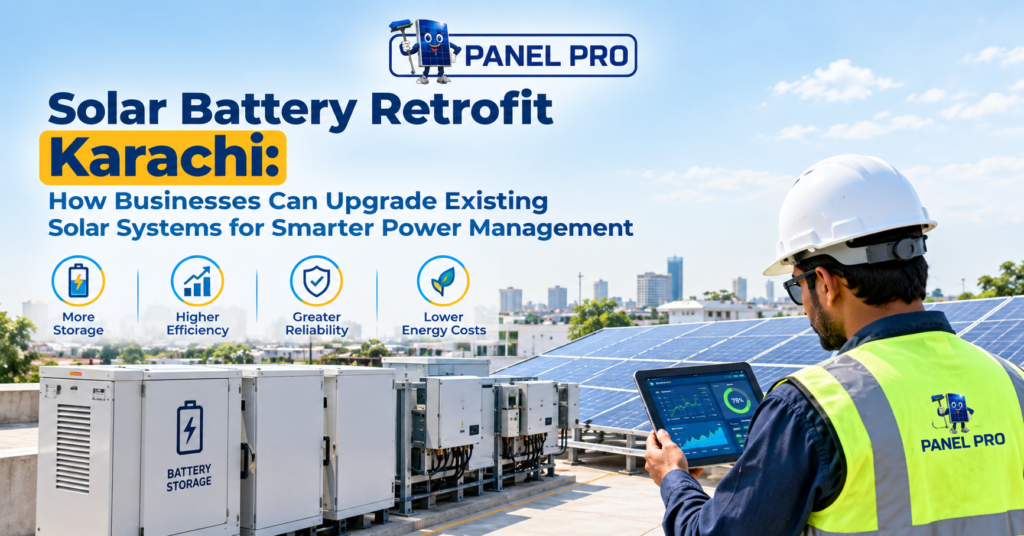
Karachi’s commercial solar market is moving into a new phase. Businesses that installed photovoltaic systems primarily for daytime generation are now looking at what happens when solar production falls, electricity demand continues, or operational loads extend beyond sunlight hours. This shift is creating interest in Solar Battery Retrofit Karachi as an alternative to replacing an entire existing solar installation.
A retrofit adds battery storage and the necessary control equipment to an existing solar system. Instead of treating solar generation and electricity consumption as separate events, businesses can use stored energy as part of a more flexible power strategy.
The timing is significant. Recent analysis reported that distributed solar supplied around 27% of Pakistan’s electricity consumption in 2025, highlighting how quickly decentralised generation has expanded.
Why Existing Solar Systems Need a New Strategy
Many commercial solar systems generate their highest output around midday. However, a business may have significant electricity requirements later in the afternoon or evening.
Without storage, excess generation may not always align with the company’s actual demand profile.
A commercial solar battery Karachi solution changes this relationship by allowing surplus solar electricity to be stored and used later.
For an existing PV installation, this can be particularly relevant when the business has already invested in panels, inverters, structures, and electrical infrastructure.
Instead of starting from scratch, a carefully designed retrofit can add another layer of energy management.
What Is a Solar Battery Retrofit?
A Solar Battery Retrofit Karachi project involves integrating battery storage with an existing solar installation.
The exact configuration depends on the existing inverter, electrical architecture, load profile, available space, battery technology, and required backup capacity.
A professional assessment should therefore happen before selecting battery capacity.
The objective isn’t simply to install the largest battery available.
The system should match the business’s actual electricity consumption and operational requirements.
Existing Solar Plus Storage
A conventional solar installation produces electricity when sunlight is available.
A battery adds the ability to shift some of that energy to another period.
This makes solar battery backup Karachi particularly relevant for businesses that need greater flexibility between solar generation and electricity demand.
The battery can potentially support selected loads when solar generation falls, depending on the system design and applicable operating conditions.
Why Battery Retrofitting Is Becoming More Relevant in Karachi
Karachi businesses operate across a wide range of commercial and industrial environments, from offices and retail facilities to warehouses and production sites.
Their electricity profiles aren’t identical.
Some businesses consume most of their power during daylight hours. Others continue operating well into the evening.
A commercial solar battery Karachi assessment should therefore begin with actual load data rather than assumptions.
This becomes even more important as Pakistan’s regulatory environment evolves. NEPRA‘s 2026 legal framework includes the Prosumer Regulations 2026 and subsequent amendments, creating a changed environment for distributed-generation customers.
For businesses planning future solar investments, this makes energy utilisation increasingly important alongside generation capacity.
Three Reasons Businesses Are Considering Storage
Better Use of Existing Solar Generation
An existing PV system may generate electricity at times when the business doesn’t need all of it.
With a Solar Battery Retrofit Karachi configuration, some surplus generation can be stored rather than immediately lost from the business’s energy-use cycle.
The actual financial benefit depends on the site’s load profile, tariff structure, system configuration, battery efficiency, and operating strategy.
More Flexible Backup Planning
A solar battery backup Karachi system can provide stored energy for selected loads when the solar system isn’t generating.
This doesn’t automatically mean that an entire facility can operate indefinitely during a grid interruption.
Instead, the system can be engineered around priority loads such as IT equipment, communications, security systems, selected lighting, refrigeration, or other critical equipment.
Better Load Management
Battery storage can also support load shifting.
A business can potentially charge the battery during periods of solar availability and discharge it later according to its energy strategy.
This turns the solar installation into a more flexible energy asset.
What Should Be Checked Before a Retrofit?
A Solar Battery Retrofit Karachi project should start with a technical assessment.
The existing solar inverter needs to be evaluated for compatibility with the proposed storage architecture.
The electrical distribution system should also be reviewed.
Technicians should examine:
- Existing PV capacity
- Inverter specifications
- Daily electricity consumption
- Peak demand patterns
- Critical loads
- Available installation space
- Electrical protection
- Battery location and ventilation requirements
- Existing monitoring infrastructure
The assessment should also consider whether the business requires whole-site backup or only selected-load support.
Choosing the Right Battery Capacity
A common mistake is choosing battery capacity based only on the size of the solar array.
A 100 kW solar system doesn’t automatically require a particular battery size.
Battery design should instead consider how much energy the business needs to shift or back up, how long priority loads need support, and when solar generation is available.
For battery storage for solar Karachi, these calculations are particularly important because excessive capacity can increase project cost without providing proportional operational value.
Likewise, an undersized battery may fail to meet the business’s intended objective.
Why Professional Integration Matters
Adding storage to an existing solar installation isn’t simply a matter of connecting batteries.
The retrofit needs appropriate electrical protection, control logic, monitoring, isolation, and compatibility between existing and new equipment.
The system also needs a clear operating strategy.
For example, should the battery prioritise solar self-consumption?
Should it reserve capacity for backup?
Should it respond to particular load conditions?
These questions should be answered before installation.
PanelPro can help businesses assess existing solar installations and develop practical upgrade strategies around system condition, performance, and future energy requirements.
The Karachi Solar Market Is Moving Toward Flexibility
The scale of distributed solar in Pakistan is changing the way businesses think about electricity.
Recent analysis estimated that distributed solar generated approximately 51 TWh in Pakistan during 2025, equivalent to around 27% of electricity consumption.
At the same time, NEPRA’s 2026 regulatory framework has introduced a new Prosumer regime and subsequent amendments, making the economics and operation of distributed energy an increasingly important consideration for solar owners.
This creates a stronger case for businesses to examine how they consume solar energy rather than focusing only on how much electricity their panels generate.
A commercial solar battery Karachi project can form part of that transition.
When Should a Business Consider a Retrofit?
A Solar Battery Retrofit Karachi assessment may make sense when an existing solar system produces substantial daytime energy but the business has significant later-day consumption.
It can also be relevant when the business needs selected-load backup, wants greater control over stored solar energy, or is reviewing its long-term energy strategy.
However, every site is different.
The correct battery configuration depends on the existing system, load profile, technical requirements, and applicable commercial considerations.
FAQs
Solar Battery Retrofit Karachi means adding battery storage and compatible control equipment to an existing solar installation instead of replacing the entire PV system.
Not automatically. A solar battery backup Karachi system can be designed for selected critical loads or broader backup, depending on battery capacity, inverter architecture, electrical design, and the business’s requirements.
There is no universal battery size. Battery storage for solar Karachi should be calculated from actual electricity consumption, critical loads, solar production, desired backup duration, and the intended operating strategy.
Not necessarily. A commercial solar battery Karachi retrofit requires a technical assessment of the existing inverter, electrical system, solar capacity, available space, load profile, and compatibility before installation.