
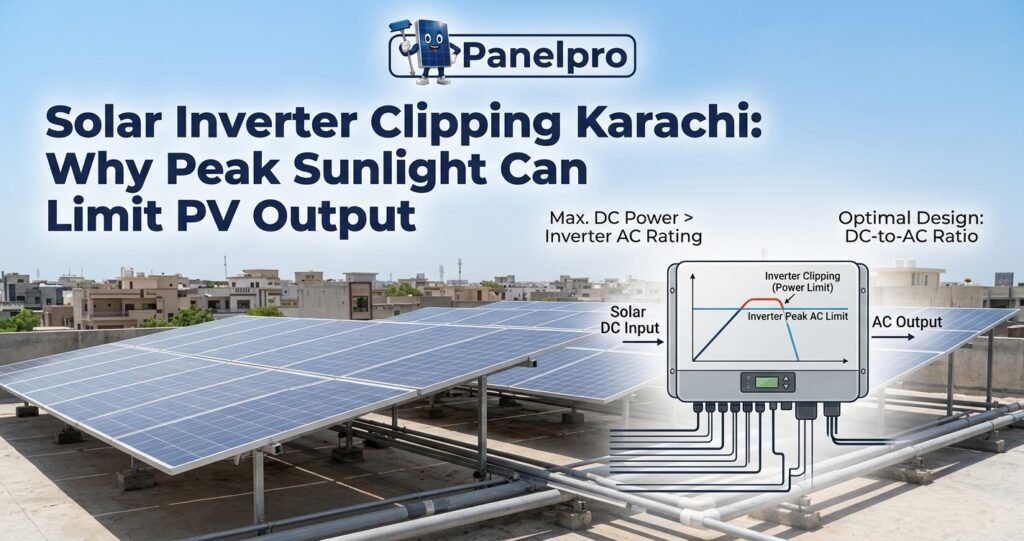
A solar The system can have healthy panels, strong sunlight, and no obvious equipment fault, yet still produce less AC power than the panel capacity suggests. One reason is Solar Inverter Clipping Karachi, a condition that becomes particularly relevant when the PV array has a higher DC capacity than the inverter’s AC output rating.
Clipping does not automatically indicate a design mistake. In many systems, developers deliberately install more DC panel capacity than inverter capacity because this approach can improve energy production during lower-irradiance periods. However, the amount and timing of clipping still matter.
Research from NREL’s photovoltaic performance modelling examines how inverter loading ratios and clipping influence PV performance and system economics.
What Is Solar Inverter Clipping?
Solar Inverter Clipping Karachi occurs when the PV array can produce more DC power than the inverter can convert into AC power at that moment.
Imagine a solar array capable of delivering 12 kW while the inverter has a 10 kW AC rating. When the array produces more power than the inverter can process, the inverter limits its output around its rated capacity.
The inverter cannot convert the additional available DC power into additional AC output.
This makes PV Clipping Losses Karachi important when evaluating system performance. A flat output curve around the inverter’s maximum rating may indicate normal clipping rather than a failed component.
Why Clipping Happens Around Peak Sunlight
The strongest sunlight does not always produce proportionally higher AC output.
During high-irradiance periods, PV modules can generate substantial DC power. When that power exceeds the inverter’s conversion limit, the inverter constrains Solar Peak Output Karachi rather than allowing the panels to increase AC production further.
This creates a characteristic production pattern. Output rises normally in the morning, approaches the inverter’s limit during stronger production hours, stays near that ceiling for a period, and then falls as irradiance decreases.
Understanding this pattern helps technicians distinguish Solar Inverter Clipping Karachi from a sudden equipment fault.
Why More Panels Can Increase Clipping
A common modern design approach uses additional DC capacity relative to inverter capacity.
NREL describes this relationship through the inverter-loading ratio, or ILR. Its 2024 benchmark assumptions use an ILR of 1.34, showing how PV systems can intentionally carry greater DC capacity than inverter AC capacity.
However, higher DC capacity can also increase PV Clipping Losses Karachi during periods when strong irradiance pushes the array beyond the inverter’s AC limit.
That does not automatically indicate poor system design.
The key question is whether the additional clipping remains justified by the extra energy that the larger DC array generates during the rest of the day and across different seasons.
Karachi’s Peak-Sun Conditions Make the Calculation Important
Karachi receives strong solar irradiance, which creates valuable production opportunities but can also make inverter limits more visible.
For a properly designed system, technicians should assess Solar Peak Output Karachi against the inverter’s actual specifications instead of simply comparing total panel wattage with daily energy production.
Temperature also matters. PV module temperature changes with irradiance and weather conditions. Sandia’s PV Performance Modeling Collaborative notes that cell temperature depends on irradiance, air temperature, wind, and module characteristics.
Therefore, panel nameplate capacity alone cannot tell you how much power a system should produce under real-world conditions.
How Inverter Capacity Testing Helps
Inverter Capacity Testing Karachi can help determine whether an apparent production limitation matches the inverter’s rated operating behaviour.
Technicians can review inverter output data, DC input behaviour, operating voltage, production curves, and historical records. This process helps them determine whether the inverter reaches its normal power ceiling or whether another issue limits production.
This distinction matters.
If the inverter repeatedly reaches its rated AC limit during strong production periods, Inverter Capacity Testing Karachi may confirm expected clipping.
If the inverter remains significantly below its expected operating range without a clear clipping pattern, technicians may need to investigate other causes.
Clipping vs a Real Performance Problem
This is where PV Clipping Losses Karachi can easily create confusion.
A system producing a flat 10 kW from a 12 kW DC array is not necessarily malfunctioning if the inverter carries a 10 kW rating and operates within its specified conditions.
On the other hand, if output suddenly falls from its normal level and does not correspond with the inverter’s capacity limit, another issue may exist.
Inverter Faults
Fault codes, abnormal shutdowns, or internal limitations can reduce output independently of normal clipping.
DC-Side Problems
Module, cable, connector, or string problems can reduce available DC power before that power reaches the inverter.
Environmental Conditions
Cloud movement, shading, and module temperature can change the amount of available PV power.
Grid Conditions
AC-side voltage and other grid conditions can also influence inverter operation.
That is why technicians should diagnose Solar Inverter Clipping Karachi from operating data instead of assuming the cause from a single power reading.
What Professional Testing Should Review
A useful Inverter Capacity Testing Karachi process should examine the complete relationship between the PV array and inverter.
Technicians can compare:
- installed DC capacity;
- inverter AC rating;
- DC-to-AC ratio;
- historical maximum output;
- peak production periods;
- inverter alerts;
- operating voltage;
- production behaviour across comparable days.
This analysis helps determine whether Solar Peak Output Karachi reaches its expected inverter ceiling or whether another technical condition restricts production.
For commercial systems, this distinction can prove especially important because recurring power limitations can affect how owners interpret production data and expected energy yield.
Turning Clipping Data Into Better O&M Decisions
PV Clipping Losses Karachi should not automatically lead to an inverter replacement.
Instead, technicians should evaluate the entire system design.
If additional DC capacity produces more useful energy during morning, afternoon, and lower-irradiance periods, some clipping during high-production periods may represent an intentional design trade-off.
However, if actual operating behaviour differs substantially from the expected design model, professional assessment can help identify the reason.
PanelPro provides solar inspection, performance testing, monitoring, and O&M support for systems that require detailed investigation of operating behaviour.
The objective is straightforward: understand what the system actually does before deciding what needs to change.
Why Solar Inverter Clipping Matters in 2026
As solar systems become larger and DC-to-AC ratios become increasingly important design considerations, Solar Inverter Clipping Karachi deserves greater attention from system owners.
Modern PV analysis increasingly examines more than total monthly generation. It also examines how systems behave throughout the day.
For Karachi solar owners, Solar Peak Output Karachi can provide useful information about whether the inverter reaches its intended operating ceiling.
Meanwhile, Inverter Capacity Testing Karachi can help distinguish expected power limiting from genuine underperformance.
Understanding PV Clipping Losses Karachi can therefore turn a confusing flat production curve into useful engineering information.
FAQs
Solar Inverter Clipping Karachi occurs when the PV array can produce more DC power than the inverter can convert into AC power, causing the inverter to limit its output.
No. PV Clipping Losses Karachi can be an intentional consequence of installing additional DC capacity relative to the inverter. The important issue is whether the overall system design benefits justify the clipping.
Solar Peak Output Karachi can be assessed by reviewing inverter output, PV capacity, operating conditions and production curves to determine whether the system is reaching its expected AC limit.
Inverter Capacity Testing Karachi helps determine whether an inverter is operating normally at its rated limit or whether another technical issue is preventing the system from reaching expected output.