
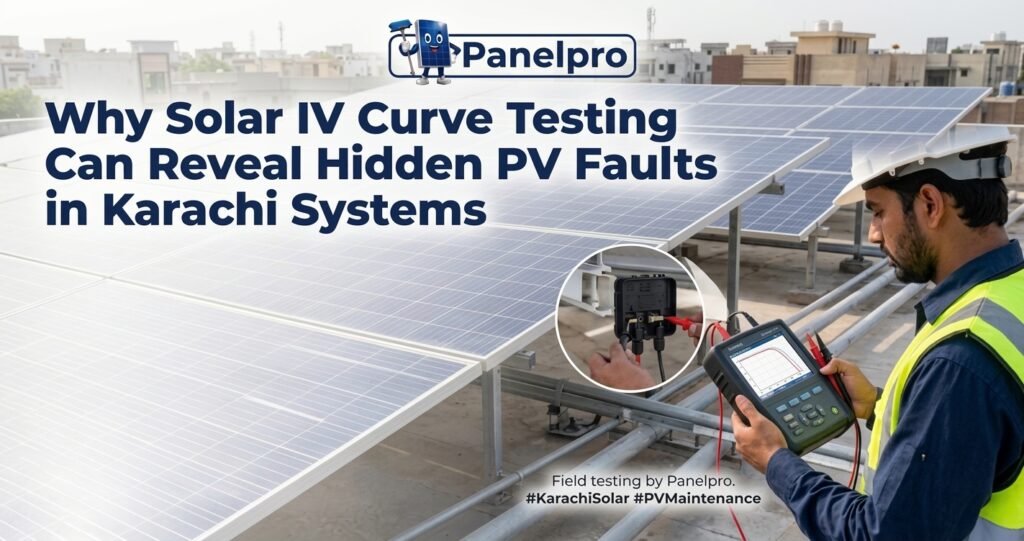
A solar system can keep running while quietly losing performance. The inverter may show normal operation, yet a module, connection, bypass diode or string can behave differently from the expected electrical profile. That is why Solar IV Curve Testing Karachi is becoming a valuable diagnostic method for serious PV maintenance.
An I-V curve records the relationship between current and voltage across a PV source. Comparing the measured curve with an expected curve can reveal abnormalities that ordinary visual inspection may miss. Recent research published in 2026 also continues to develop faster I-V characterization methods for real-time PV fault detection.
What I-V Curve Testing Actually Shows
Solar IV Testing Karachi provides a much deeper electrical picture than checking whether an inverter is switched on.
A technician can examine parameters such as open-circuit voltage, short-circuit current, maximum-power voltage and maximum-power current. The overall curve shape can then be compared with an expected reference.
This makes PV IV Curve Diagnostics Karachi useful when a system produces less energy than expected but does not display an obvious equipment alarm.
Fluke’s current technical guidance explains that I-V curve deviations can help identify conditions including shading, soiling, wiring problems, damaged cells and component degradation.
Hidden Problems Can Appear in the Curve
One reason PV Fault Detection Karachi deserves attention is that different problems can produce different curve signatures.
A stepped curve may indicate current mismatch, while unusually low current can point toward shading, soiling or degradation. Abnormal voltage behaviour can indicate other electrical or module-related issues.
This makes Solar IV Curve Testing Karachi particularly useful when production data alone cannot explain a performance decline.
Instead of immediately replacing a component, technicians can investigate the electrical evidence first.
Why This Matters for Karachi Solar Systems
Karachi PV installations operate through intense sunlight, changing temperatures, dust and varying rooftop conditions. These factors can influence PV output, but they do not automatically explain every performance decline.
Solar IV Testing Karachi can help distinguish environmental effects from genuine electrical abnormalities.
A proper test should use suitable irradiance and temperature measurements so that the measured curve can be compared fairly with expected behaviour.
That makes PV IV Curve Diagnostics Karachi more valuable than relying on one isolated voltage or current reading.
I-V Testing Is Moving Toward Faster Diagnostics
The technology behind PV Fault Detection Karachi is also developing.
A 2026 research study presented an online I-V tracing system capable of acquiring a complete curve in under one second for high-voltage PV strings. The researchers reported less than 2% deviation between measured and theoretical results in their testing.
Another 2026 study combined I-V data with computer vision and reported 96.7% end-to-end diagnostic accuracy in its experimental framework.
These developments show how PV maintenance is moving toward data-based diagnosis rather than relying only on visual inspection.
From Testing to Targeted Maintenance
The real value of Solar IV Curve Testing Karachi comes after the measurement.
If the curve indicates abnormal behaviour, technicians can investigate the affected module, wiring, bypass diode, shading condition or other relevant component.
Solar IV Testing Karachi therefore becomes part of a broader troubleshooting process rather than a standalone measurement.
For commercial installations, this approach can help maintenance teams focus their attention on evidence-based problems.
PanelPro provides solar inspection, performance testing, O&M and monitoring services that can support this type of technical approach.
Why Owners Should Track Electrical Performance
A single test provides a snapshot. Repeated PV IV Curve Diagnostics Karachi can create a historical reference that helps identify changes over time.
This is particularly useful when a system gradually loses output without a clear failure event.
By combining monitoring data with PV Fault Detection Karachi, technicians can investigate performance changes before they become larger operational concerns.
For modern solar assets, Solar IV Curve Testing Karachi is therefore moving from specialist troubleshooting toward a more structured performance-management tool.
FAQs
Solar IV Curve Testing Karachi measures the current-voltage relationship of PV modules or strings to identify deviations from expected electrical performance.
Solar IV Testing Karachi can help investigate shading, soiling, wiring problems, damaged cells, bypass-diode issues and other electrical abnormalities.
PV IV Curve Diagnostics Karachi provides detailed electrical information that ordinary visual inspection or inverter status screens may not reveal.
PV Fault Detection Karachi is particularly useful when a solar system shows unexplained underperformance, abnormal string behaviour or gradual output changes without an obvious alarm.